
Encapsulating conditional logic is a powerful design technique in software development. By wrapping complex conditionals into clearly named methods or leveraging polymorphism, you can make your C# code more expressive, maintainable, and testable. This article explores practical approaches and examples for applying this concept in C#.
Why Encapsulate Conditional Logic?
- Readability: Well-named methods or classes communicate intent, making code easier to understand at a glance.
- Maintainability: Changes to business rules are isolated, reducing the risk of introducing bugs elsewhere.
- Testability: Encapsulated logic can be unit tested independently, improving reliability.
- Abstraction: Hides unnecessary details, exposing only what matters for the current context.
Method 1: Extracting Conditionals into Named Methods
Complex Boolean expressions in if, switch, or ternary statements can obscure intent. Extracting them into methods with descriptive names clarifies their purpose.
Example:
public class Order
{
    public bool IsEligibleForDiscount(Customer customer, int quantity)
    {
        return IsSeniorOrEmployee(customer) && HasSufficientStock(quantity);
    }

    private bool IsSeniorOrEmployee(Customer customer)
    {
        return customer.Age >= 60 || customer.IsEmployee;
    }

    private bool HasSufficientStock(int quantity)
    {
        return quantity > 0 && StockCount > 0;
    }
    public int StockCount { get; set; }
}
Usage:
if (order.IsEligibleForDiscount(customer, quantity))
{
    // Apply discount logic
}
This approach makes the business rule explicit and the code self-explanatory¹.
Method 2: Using Polymorphism to Replace Conditionals
When conditional logic branches based on object type or state, polymorphism can eliminate if-else or switch statements, leading to more scalable and flexible code.
Example: Payment Processing
Suppose you have different payment types, each with unique processing logic:
public abstract class Payment
{
    public abstract void Pay();
}

public class CreditCardPayment : Payment
{
    public override void Pay()
    {
        Console.WriteLine("Processing credit card payment.");
    }
}

public class PayPalPayment : Payment
{
    public override void Pay()
    {
        Console.WriteLine("Processing PayPal payment.");
    }
}
Without Polymorphism:
public void ProcessPayment(object payment)
{
    if (payment is CreditCardPayment cc)
        cc.Pay();
    else if (payment is PayPalPayment pp)
        pp.Pay();
    // More conditions...
}
With Polymorphism:
public void ProcessPayment(Payment payment)
{
    payment.Pay();
}
This pattern adheres to the Open/Closed Principle: you can add new payment types without modifying existing logic.
The Problem with Complex Conditionals
Conditional statements (if, switch, etc.) are fundamental to programming but become problematic when they grow unwieldy. Consider a scenario where an e-commerce system applies discounts based on customer status, order quantity, and product availability:
if ((customer.Age >= 60 || customer.IsEmployee)
    && (quantity > 0 && stockCount > 0)
    && !order.IsDisputed)
{
    ApplyDiscount(0.15);
}
Such code violates the Single Responsibility Principle and becomes a maintenance burden. Changes to business rules risk introducing bugs, and testing requires covering every branching path.
Design Patterns for Encapsulating Conditionals
1. Specification Pattern: Modular Business Rules
The Specification Pattern encapsulates conditional logic into reusable, composable objects. Each specification represents a business rule, enabling declarative combinations like And, Or, and Not.
Implementation Example:
public interface ISpecification<T>
{
    bool IsSatisfiedBy(T candidate);
}

public class SeniorOrEmployeeSpecification : ISpecification<Customer>
{
    public bool IsSatisfiedBy(Customer customer)
        => customer.Age >= 60 || customer.IsEmployee;
}

public class InStockSpecification : ISpecification<Order>
{
    public bool IsSatisfiedBy(Order order)
        => order.StockCount > 0 && order.Quantity > 0;
}

// Usage
var discountSpec = new SeniorOrEmployeeSpecification()
    .And(new InStockSpecification())
    .And(new NonDisputedOrderSpecification());
if (discountSpec.IsSatisfiedBy(context))
{
    ApplyDiscount(0.15);
}
This approach decouples validation logic from domain entities, enabling unit testing of individual specifications and dynamic rule composition.
2. Strategy Pattern: Interchangeable Algorithms
The Strategy Pattern encapsulates conditional branches into interchangeable strategy objects. It is ideal for scenarios where multiple algorithms vary based on runtime conditions, such as payment processing or report generation.
Example: Payment Processing
public interface IPaymentStrategy
{
    void ProcessPayment(decimal amount);
}

public class CreditCardStrategy : IPaymentStrategy
{
    public void ProcessPayment(decimal amount)
        => Console.WriteLine($"Processing credit card: {amount:C}");
}

public class PayPalStrategy : IPaymentStrategy
{
    public void ProcessPayment(decimal amount)
        => Console.WriteLine($"Processing PayPal: {amount:C}");
}

// Context class
public class PaymentProcessor
{
    private IPaymentStrategy _strategy;
    public void SetStrategy(IPaymentStrategy strategy)
        => _strategy = strategy;
    public void ExecutePayment(decimal amount)
        => _strategy?.ProcessPayment(amount);
}

// Usage
var processor = new PaymentProcessor();
processor.SetStrategy(new CreditCardStrategy());
processor.ExecutePayment(100.00m);
By delegating to strategy objects, the context class avoids rigid conditional checks and adheres to the Open/Closed Principle.
3. State Pattern: Behavior by State
The State Pattern replaces state-specific conditionals with polymorphic state objects. This is particularly useful for finite state machines, such as order workflows or UI components.
Example: Vending Machine States
public interface IState
{
    void InsertCoin(VendingMachine machine);
    void SelectProduct(VendingMachine machine);
    void Dispense(VendingMachine machine);
}

public class WaitingForCoinState : IState
{
    public void InsertCoin(VendingMachine machine)
    {
        Console.WriteLine("Coin accepted.");
        machine.SetState(new ProductSelectionState());
    }
    public void SelectProduct(VendingMachine machine)
        => Console.WriteLine("Insert coin first.");
    public void Dispense(VendingMachine machine)
        => Console.WriteLine("Insert coin and select product.");
}

// Context class
public class VendingMachine
{
    private IState _currentState = new WaitingForCoinState();
    public void SetState(IState state)
        => _currentState = state;
    public void InsertCoin()
        => _currentState.InsertCoin(this);
    public void SelectProduct()
        => _currentState.SelectProduct(this);
    public void Dispense()
        => _currentState.Dispense(this);
}
Each state encapsulates transitions and actions, eliminating switch statements over enum values.
4. Template Method Pattern: Skeletal Algorithms
The Template Method Pattern defines an algorithm’s structure in a base class while delegating conditional steps to subclasses. This is common in frameworks requiring extensible workflows.
Example: Data Export Pipeline
public abstract class DataExporter
{
    public void Export()
    {
        ValidateInput();
        TransformData();
        if (NeedsCompression())
            Compress();
        Save();
    }

    protected abstract void ValidateInput();
    protected abstract void TransformData();
    protected virtual bool NeedsCompression() => false;
    protected virtual void Compress()
        => Console.WriteLine("Compressing data...");
    protected abstract void Save();
}

public class CsvExporter : DataExporter
{
    protected override void ValidateInput()
        => Console.WriteLine("Validating CSV data...");
    protected override void TransformData()
        => Console.WriteLine("Converting to CSV format...");
    protected override void Save()
        => Console.WriteLine("Saving CSV file...");
}

public class JsonExporter : DataExporter
{
    protected override void ValidateInput()
        => Console.WriteLine("Validating JSON data...");
    protected override void TransformData()
        => Console.WriteLine("Serializing to JSON...");
    protected override bool NeedsCompression() => true;
    protected override void Save()
        => Console.WriteLine("Saving compressed JSON...");
}
Subclasses override hooks like NeedsCompression(), localizing conditional logic.
5. Visitor Pattern: Extending Object Behaviors
The Visitor Pattern externalizes operations from object structures, enabling new behaviors without modifying existing classes. It is useful for complex hierarchies like abstract syntax trees⁸.
Example: Document Element Processing
public interface IDocumentElement
{
    void Accept(IVisitor visitor);
}

public class TextElement : IDocumentElement
{
    public string Content { get; set; }
    public void Accept(IVisitor visitor)
        => visitor.VisitText(this);
}

public class ImageElement : IDocumentElement
{
    public string Url { get; set; }
    public void Accept(IVisitor visitor)
        => visitor.VisitImage(this);
}

public interface IVisitor
{
    void VisitText(TextElement text);
    void VisitImage(ImageElement image);
}

public class HtmlExportVisitor : IVisitor
{
    public void VisitText(TextElement text)
        => Console.WriteLine($"<p>{text.Content}</p>");
    public void VisitImage(ImageElement image)
        => Console.WriteLine($"<img>");
}

// Usage
var elements = new IDocumentElement[] { new TextElement(), new ImageElement() };
var visitor = new HtmlExportVisitor();
foreach (var element in elements)
    element.Accept(visitor);
Visitors centralize conditional type checks, promoting separation of concerns.
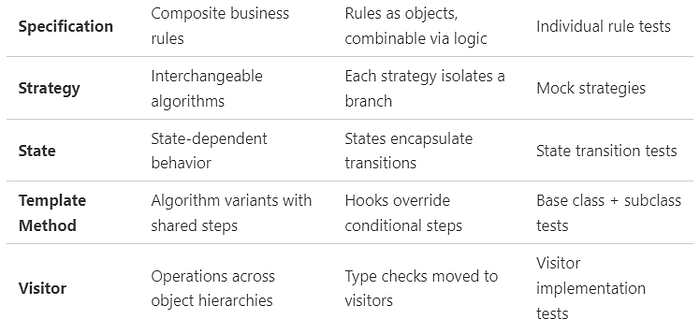
Comparative Analysis of Patterns
Best Practices
- Use meaningful method names: Clearly convey the intent of the condition.
- Keep methods focused: Each method should encapsulate a single logical decision.
- Leverage interfaces and abstract classes: For polymorphic solutions, define clear contracts.
- Avoid type-checking: Prefer method overriding to explicit type checks or casting.
- Extract complex conditions into variables: Even within a method, assigning complex conditions to well-named variables aids clarity.
Conclusion
Encapsulating conditional logic-whether through simple method extraction or by applying design patterns like Specification, Strategy, State, Template Method, and Visitor-leads to cleaner, more maintainable, and more testable C# code. These patterns not only clarify business logic but also prepare your codebase for future changes and extensions, embodying the principles of clean code and robust software design.
By choosing the right pattern for your scenario, you can transform fragile, hard-to-test branches into modular, expressive, and resilient code-cornerstones of professional software craftsmanship.