
I’m thrilled to share that the first section of our Microservices course is now complete! 🚀 This extensive course designed for software developers, architects, and technology enthusiasts who want to master end-to-end microservices development.
Course Link:- https://www.udemy.com/course/building-amazon-style-full-stack-microservices/?couponCode=BEST-PRICE
Github Link:- https://github.com/rahulsahay19/Dot-Net-Core-Microservices-Full-Stack
https://github.com/rahulsahay19
This course dives deep into building scalable, event-driven microservices with .NET Core, RabbitMQ, Mongo Db, SQL Server, Redis, Saga Pattern, Outbox Pattern, Repository Pattern, Specification Pattern and many more for guaranteed consistency across distributed transactions. Every module is crafted with real-world use cases, hands-on coding, and enterprise-ready design patterns.

In this journey, we built a robust microservices ecosystem right from scratch, covering a plethora of services including:
- 🛒 Catalog Service
- 🧺 Basket Service
- 🎟 Discount Service
- 📦 Ordering Service
- 💳 Payment Service
- 🔐 Identity Service
Along the way, we also implemented essential architecture patterns that real-world systems rely on:
- ✅ CQRS (Command Query Responsibility Segregation)
- ✅ SAGA (Orchestration & Choreography)
- ✅ Outbox Pattern
- ✅ Repository & Specification Patterns
- ✅ Factory Pattern … and many more.
This foundation gives you production-grade backend microservices with clean design, scalability, and resilience built-in.
Application Flow:
This is the high-level flow of our application.
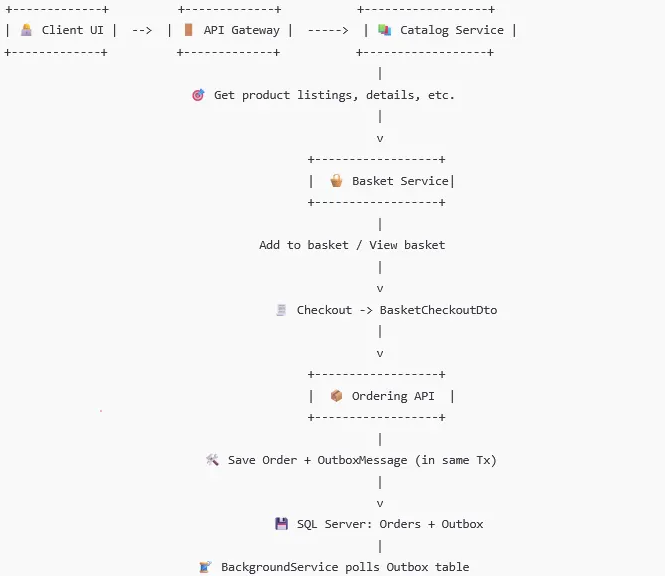
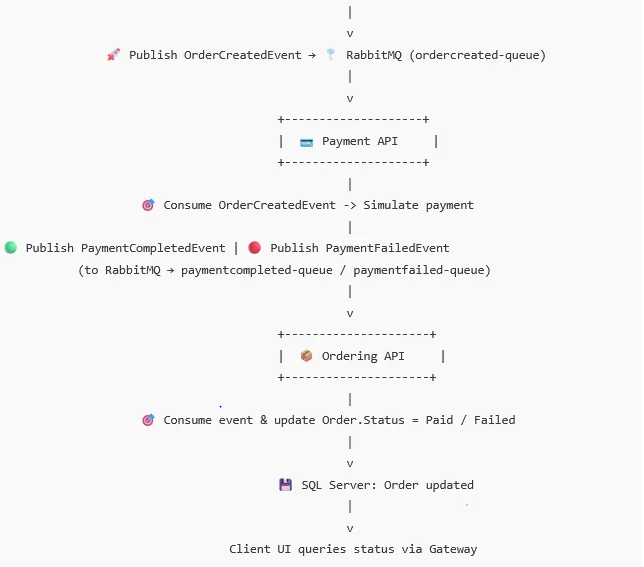
This course doesn’t just stop at coding — it walks you through how enterprise-grade systems are designed and executed in production. Here’s a breakdown of the application flow:
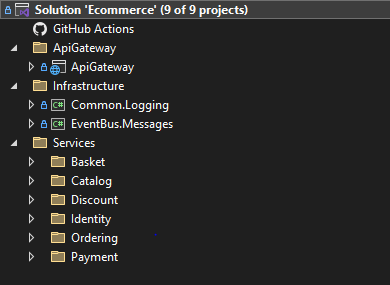
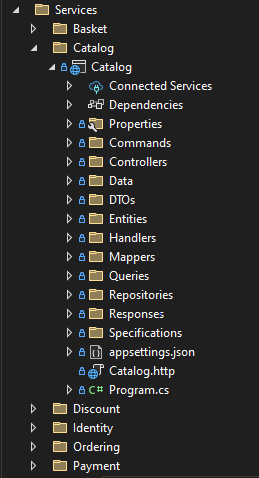
Solution View:
1. Catalog Microservice
- Manages product inventory and categories.
- Exposes REST APIs for the frontend.
- Uses Mongo Db as the primary store.
- Publishes events when products are updated.
2. Basket Microservice
- Implements a user shopping cart.
- Stores session data in Redis for low-latency access.
- Consumes Catalog events to keep basket items consistent.
3. Discount Microservice
- Independent service backed by PostgreSQL.
- Exposes gRPC APIs for coupon validation.
4. Ordering Microservice
- Core domain handling checkout, order creation, and persistence.
- Implements CQRS for command-query separation.
- Uses SQL Server as database Store.
- Uses Outbox Pattern to guarantee reliable event publishing.
- Works with the Saga Pattern to coordinate distributed transactions.
5. Payment Microservice
- Processes secure transactions.
- Publishes
Payment.SucceededandPayment.Failedevents to RabbitMQ. Payment.Failedtriggers Saga compensating transactions (rollback).
6. Event-Driven Communication with RabbitMQ
- Microservices communicate asynchronously via RabbitMQ.
- Guarantees loose coupling, reliability, and eventual consistency.
💡 What’s Coming Next (Phase 2)
We’re not stopping here! In the second phase, we’ll add the Frontend layer with Angular and its cousin technologies to bring this system alive as a full end-to-end application. This will let us experience the entire flow — from UI → API Gateway → Microservices → Databases.
⚡ Future Roadmap (Phase 3)
In the third phase, we’ll level up by embracing infrastructure and cloud-native practices, such as:
- 🐳 Docker & 🧑✈️ Kubernetes for containerization & orchestration
- ☁️ Azure cloud services & cloud-native building blocks
- 🔄 CI/CD pipelines for automation
- 🌐 Service Mesh, Observability (Grafana, Prometheus), Logging
- 🔒 Security best practices
This will make our project enterprise-ready — just like real-world systems run in production.
🔑 Why This Course is Worth It
✅ 20+ Hours of Premium Content — Straight to the point, full-stack development of a real-world system.
✅ Enterprise Patterns Covered — Saga, Outbox, CQRS, Repository, Specification, and Event-Driven Messaging.
✅ Polyglot Persistence — SQL Server, PostgreSQL, and Redis, each chosen for the right workload.
✅ Production-Ready — Dockerized microservices, secure API Gateway, and asynchronous workflows.
✅ Cloud Native Orientation — Designed with deployment to Azure/Kubernetes in mind.