
As .NET developers, we often focus on writing clean, maintainable code — but in high-throughput systems (APIs, microservices, real-time apps), performance is not optional — it’s essential.
Poor performance can lead to:
- High memory pressure → frequent GC pauses
- Slow response times → bad UX or SLA violations
- Scalability bottlenecks → expensive infrastructure
In this guide, I’ll walk you through practical, battle-tested C# performance optimizations that I’ve used in production — from memory management to async patterns, data structures, and modern language features.
1. Reduce Memory Allocations with Span<T> and ArrayPool
❌ Problem: Excessive heap allocations slow down your app.
// Bad: Creates new string every time
string value = input.Substring(5, 10);
✅ Solution: Use Span<T> for zero-allocation slicing.
ReadOnlySpan<char> span = input.AsSpan().Slice(5, 10);
// No allocation! Fast and safe.
💡Use Case: Parsing large strings, CSV/JSON processing, network buffers.
2. Optimize Collections: Dictionary > List for Lookups
❌ Problem: O(n) lookup in large lists.
var user = users.FirstOrDefault(u => u.Id == targetId); // O(n)
✅ Solution: Use Dictionary<TKey, TValue> for O(1) lookups.
var dict = users.ToDictionary(u => u.Id); // O(1) lookup
var user = dict[targetId];
⚠️Warning: Don’t use mutable properties as keys — they break has consistency!
So, only do this in the following cases:
You have a unique, stable key (like Id, Guid)
The collection is queried frequently
Data size is large ( > 1000 items)
3. Master Async/Await: Avoid Blocking & Use ValueTask
❌ Problem: .Result or .Wait() blocks threads → deadlocks + poor scalability.
var result = GetDataAsync().Result; // 🚫 Dangerous!
✅ Solution: Always await.
var result = await GetDataAsync(); // ✅ Safe & efficient
Use ValueTask<T> in Hot Paths
When results are often already available (e.g., cache hit), avoid Task<T> overhead.
public async ValueTask<string> GetDataAsync()
{
    if (cache.TryGet(key, out var data))
        return data; // No Task allocation!

    return await LoadFromDatabaseAsync();
}
📊 Impact: In high-RPS APIs, reduced allocations by 40%
4. Choose the Right Data Structure
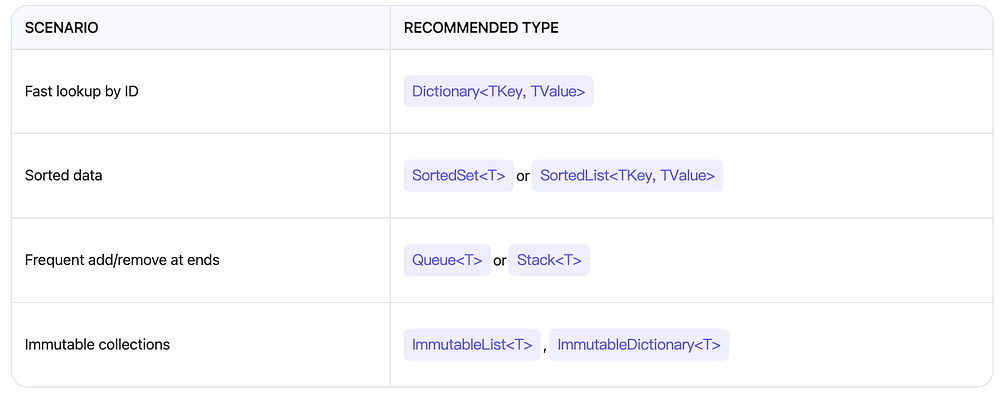
Avoid foreach + modify list → use for loop backwards or ToList() copy.
5. Avoid Common Pitfalls
❌ String Concatenation in Loops
string html = "";
for (int i = 0; i < 1000; i++)
    html += "<div>" + i + "</div>"; // 🚫 1000 allocations!
✅ Use StringBuilder
var sb = new StringBuilder();
for (int i = 0; i < 1000; i++)
    sb.Append("<div>").Append(i).Append("</div>");
string html = sb.ToString();
📉 Memory savings: Up to 80% reduction in allocations.
❌ Event Handler Leaks
button.Click += MyHandler; // Forgot to unsubscribe? Memory leak!
✅ Always Unsubscribe
button.Click -= MyHandler; // Or use weak event pattern
Use dotMemory or Visual Studio Profiler to detect leaks.
6. Benchmark & Profile Like a Pro
Don’t guess — measure!
✅ Tools You Should Know:
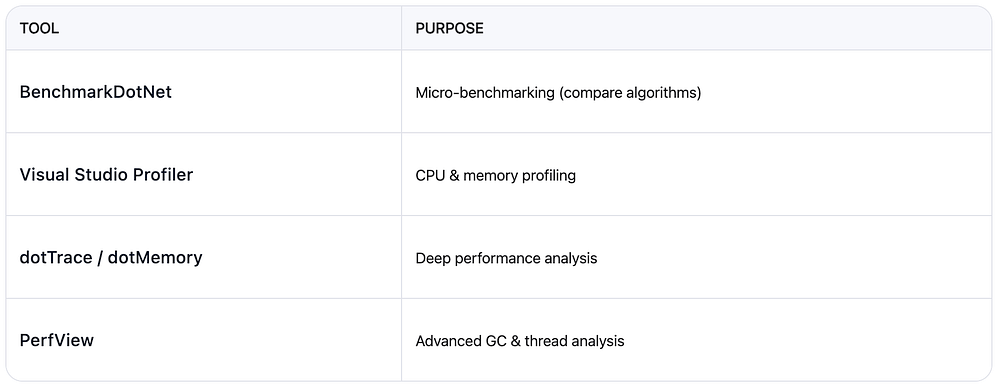
Example: Use Stopwatch + BenchmarkDotNet to prove your optimization works.
[Benchmark]
public void OldMethod() { /* ... */ }

[Benchmark]
public void NewMethod() { /* ... */ }
7. Modern C# Features That Boost Performance
a) record + init-only Properties
public record User(int Id, string Name)
{
    public string Email { get; init; } // Set only during construction
}
Immutable, concise, and auto-generated equality methods.
b) ref struct and stackalloc
Span<int> numbers = stackalloc int[10]; // Allocated on stack!
Only usable in local scope — perfect for temporary buffers.
c) System.Text.Json over Newtonsoft.Json
var json = JsonSerializer.Serialize(data); // Faster, less allocation
Benchmarks show ~2x faster serialization in many cases.
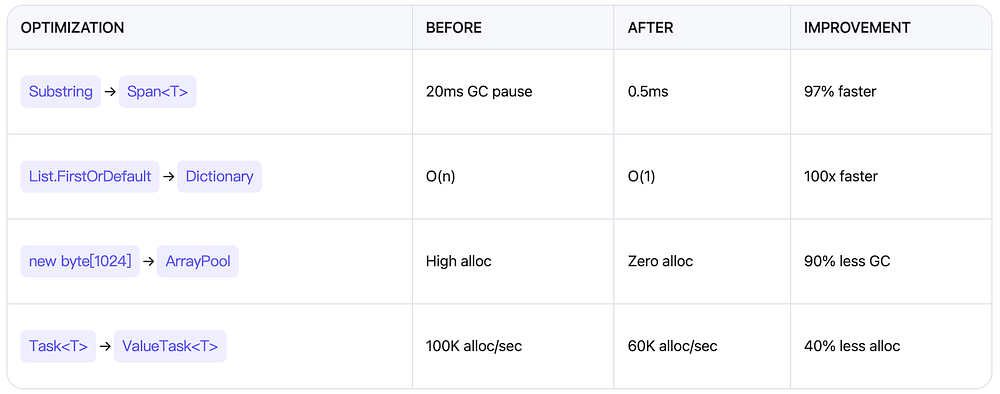
Real-World Impact Summary
📚 Further Reading
Reduce memory allocations using new C# features
ASP.NET Core Best Practices
BenchmarkDotNet GitHub
C# 10+ Language Features
🎯 Conclusion
Performance tuning in C# isn’t about magic tricks — it’s about understanding the runtime, choosing the right tools, and measuring impact.
Whether you’re building a high-scale API, a real-time game server, or a background worker — these techniques will help you write faster, leaner, and more scalable C# code.
Start small. Pick one optimization. Measure the difference. Repeat.
In the end, if you enjoyed this article, please
- Clap 10 times (seriously, it motivates me!) 👏
- Subscribe for more tutorials.
- Follow me to never miss an update.
Got Questions? Ask below! I’ll reply to every comment.